

Notice: Unfortunately, we are presently not accepting new cases of this type.
Your North Carolina driving record follows you everywhere.
Insurance companies review it to set your rates, employers check it before extending job offers, and the DMV uses it to determine whether your license stays valid.
A single conviction or reporting error can have serious consequences for your finances and your driving privileges.
If a traffic violation, accident, or error has affected your record, and you’re dealing with the fallout, the attorneys at Kreger Brodish LLP are here to help.
Contact us today to discuss your situation at a free, fully confidential initial consultation.
What Is a North Carolina Driving Record?
Your North Carolina driving record, also called a motor vehicle report (MVR), is an official document maintained by the North Carolina Division of Motor Vehicles (NCDMV).
It captures your full history as a licensed driver in the state.
It reflects every significant interaction you’ve had with the DMV, from the first time you received a license to your most recent renewal, along with any convictions, suspensions, or accidents tied to your name.
What Information Is Included on an NC Driving Record?
A full North Carolina driving record contains several categories of information.
Your personal details, including your name, address, date of birth, and license number, appear at the top.
Below that, you’ll find your license issuance history, including class, type, issue and expiration dates, endorsements, and any restrictions, such as those for corrective lenses or ignition interlock requirements.
The body of the record lists any convictions with associated DMV point values, the courts where charges were adjudicated, suspensions with their start and end dates, accidents, and any out-of-state withdrawals.
The total point count from convictions appears at the top of the record as well.
How to Obtain Your Driving Record
The NCDMV gives you three ways to request your driving record. They are as follows:
- You can order it online through the DMV’s website. You’ll need your name, date of birth, license number, and Social Security number to do so.
- You can submit a request by mail, though you’ll need to include a money order or certified check made payable to NCDMV and wait about 10 business days for processing.
- Finally, you can make an in-person request at the Raleigh Central Services or Huntersville License Plate Agency. If you need five records or fewer, you can receive them immediately in person.
Certified vs. Non-Certified Driving Records in North Carolina
North Carolina offers both certified and non-certified driving records. A certified record is an official legal document that bears the DMV’s raised seal.
This is the type that courts, licensing boards, and certain employers typically require. A non-certified record gives you the same underlying information but without the seal, so it’s mostly used for personal review or informal purposes.
You can request a certified record online, though you’ll need to include a written request for the raised seal.
How to Read a North Carolina Driving Record
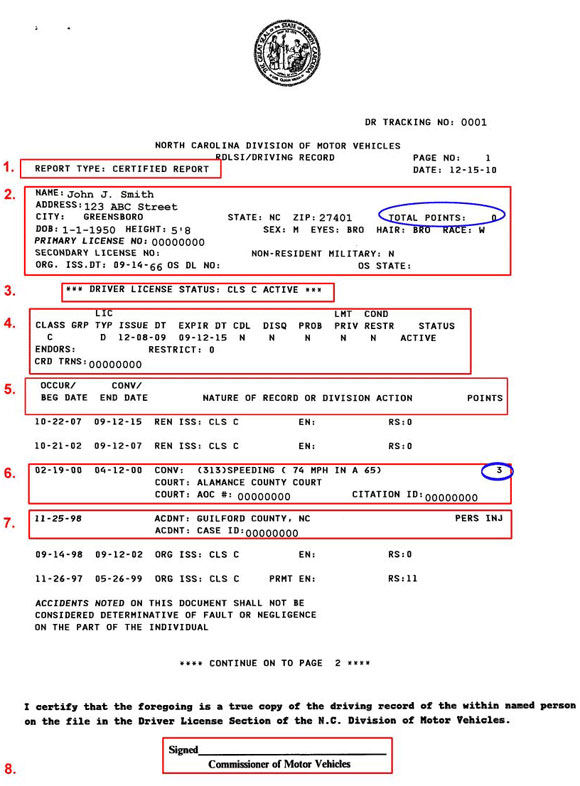
Box 1 – This box indicates the type of driving record in front of you. We recommend that you order a “certified” driving record if you plan to use the record in court.
Box 2 – This box lists your identification information such as your name, address, and driver’s license number. The most important piece of information in box 2 is circled in blue. This is your total number of Department of Motor Vehicles (DMV) points. The number of DMV points that you have can have a bearing on whether you are able to retain you driving privilege. For more information on DMV points.
Box 3 – This section tells you the current status of your North Carolina Driver’s License. In the example record, the driver’s license is active.
Box 4 – This area gives specific details about your current North Carolina Driver’s License, such as the date it was issued, when your Driver’s License is set to expire (if not renewed), and whether there are any type of restrictions associated with your Driver’s License.
Box 5 – This is the header of your actual driving record, and the corresponding information below Box 5 is the content of your driving record.
- Beginning on the left side of box 5, you have the “OCCUR/BEG DATE” column. This is the date you were charged with any traffic violations.
- Moving right in box 5, the next column is the “CONV/END DATE.” This is date that your traffic violation was disposed of by either a conviction, a guilty plea to a reduced charge, or a dismissal.
- Next in box 5 is “NATURE OF RECORD OR DIVISION ACTION.” This column tells you the nature of your traffic violation or event.
- Finally, on the far right column of box 5 is “Points.” This is the number of DMV points that you incurred because of the traffic violation or event.
Box 6 – This is the first entry on the sample driving record. As you can see, the driver was charged with speeding on 02-19-00 in Alamance County. Further, the driver was convicted of speeding, going 9 mph over the speed limit (74 mph in 65 zone) on 04-12-00. The driver received 3 DMV points as result of this conviction. It is important to note that North Carolina DMV points are much different than North Carolina insurance points (the driver in this sample record did not receive any North Carolina insurance points).
Box 7 – This box has the second entry on the sample driving record. This entry indicates that the driver was involved in an accident on 11-25-1998 in Guilford County, North Carolina. The entry also states that there was a personal injury that resulted in the accident. However, there were no criminal charges or traffic violations associated with the accident, nor did the driver receive any DMV points. Again, note that North Carolina DMV points are different than North Carolina insurance points.
If you were injured in a car accident in Durham or elsewhere in North Carolina, a Durham car accident lawyer can help you understand your options for seeking compensation.
Box 8 – This is the signature of the North Carolina Commissioner of Motor Vehicles certifying that the driving record is true and accurate. If you are using your driving record for court purposes, we recommend that use a certified copy of your driving record and that the driving record is signed by the North Carolina Commissioner.
North Carolina DMV Points and Penalties Explained
North Carolina uses a point system to track driving behavior. Each moving violation conviction adds a certain number of points to your DMV record, which varies by offense.
Reckless driving, following too closely, and hit-and-run property damage violations each carry 4 points. Running a red light or stop sign, speeding over 55 mph, and failing to yield all carry 3 points.
If you accumulate 12 or more points within three years, the DMV can suspend your license. After reinstatement, just 8 points within three years can trigger another suspension.
You can reduce your point total by 3 points if you complete a DMV-approved driver improvement clinic, though you can only do so once every five years.
How Traffic Violations Affect Your Driving Record and Insurance
A conviction for a traffic offense can drive up your auto insurance rates under North Carolina’s Safe Driver Incentive Plan (SDIP). Insurance companies assign their own point values to violations, separate from DMV points, and use those to calculate surcharges.
At-fault accidents fall into three categories: major, intermediate, and minor, and each carries different surcharge implications.
The law includes one important exception: if you’re at fault in a minor accident, carry a clean prior record, and don’t receive a moving violation conviction, your insurer generally can’t raise your rates.
How Long Can Violations Stay on Your NC Driving Record?
It depends on the violation.
Most moving violation convictions remain on your record for three years from the date of the offense. More serious offenses, such as driving while impaired, might stay on your record for longer.
The NCDMV uses a three-year window when calculating points for potential suspension, so older convictions might no longer factor into that calculation.
However, they can still appear on your full record, which insurers and employers may review.
What Does a Prayer for Judgment Continued (PJC) Mean for Your Record?
A prayer for judgment continued (PJC) is a disposition where a court finds you guilty but doesn’t impose a formal punishment.
For DMV purposes, a PJC generally won’t result in points on your driving record the first time you use it.
For insurance purposes, you can avoid a surcharge under the SDIP as long as your household receives no more than one PJC every five years. If you get a second PJC within that window, however, your insurer can treat it as a conviction.
A PJC isn’t a dismissal, and courts won’t always grant one. An attorney can evaluate whether pursuing a PJC makes sense in your specific situation.
Common Errors on Driving Records and How to Fix Them
Mistakes on North Carolina driving records are more common than most people realize.
A conviction might appear under the wrong name or license number, or a suspension could show as active long after license reinstatement.
Out-of-state convictions sometimes get reported or coded incorrectly, and accident entries occasionally reflect the wrong dates or counties. These errors can affect your insurance rates, your ability to get a job, and your license status.
A lawyer can review your full record, identify any inaccuracies, and work with the DMV or the relevant court to correct the official record before those errors cause lasting harm.
Have Questions About Your North Carolina Driving Record?
Most North Carolina drivers don’t think about their driving records until something forces them to.
If you’ve reached that point, whether because of a recent accident, a notice from the DMV, or a question about what’s on paper, contact the attorneys at Kreger Brodish LLP for a free, no-obligation consultation.


